

THE PROJECT
PROJECT DETAILS
Green Training INTernational
Program for agriculture and livestock farming and conservation (GreenTraINT)
Start: 01-11-2024 – End: 31-10-2026
Project Reference: 101179780 — GreenTraINT
EU Grant: 386,451 EUR
Programme: Erasmus+ Capacity Building Higher Education (CBHE)
GreenTraINT aims to design and implement HE programs in sustainable management practices in agriculture and livestock sectors which would then address the need for developing capacity for food production while protecting biodiversity at Seychelles. One effective strategy to integrate biodiversity conservation with food production is enhancing teaching and training programs in sustainable agroforestry techniques. The GreenTraINT project core is to fill a gap in the sector of HE offer by designing and testing an intensive program which will include a general common training component and three specific paths: “Sustainable agriculture”, “Sustainable livestock farming” and “Conservation of natural areas and biodiversity”.
A summer school will test a suite of training materials that can be used independently within the context of each training path or as part of a coherent whole course. Ultimately, the aspiration of the project is to develop teaching and training modules to be implemented at University of Seychelles and other educational institutions as a standalone program for professionals, thus giving the outcomes an impact beyond the project's period. The project consortium involves three HE Institutions (University of Bologna, Italy; University of Seychelles, Seychelles; University of Applied Sciences Coburg, Germany), an educational institution of the tertiary level (Seychelles Institute of Agriculture and Horticulture) and two further non-academic bodies (Parco Natura Viva, Italy; Seychelles Parks and Gardens Authority). Partners cover significant areas of expertise in teaching, training and research at national and international levels.
GreenTraINT STRUCTURE
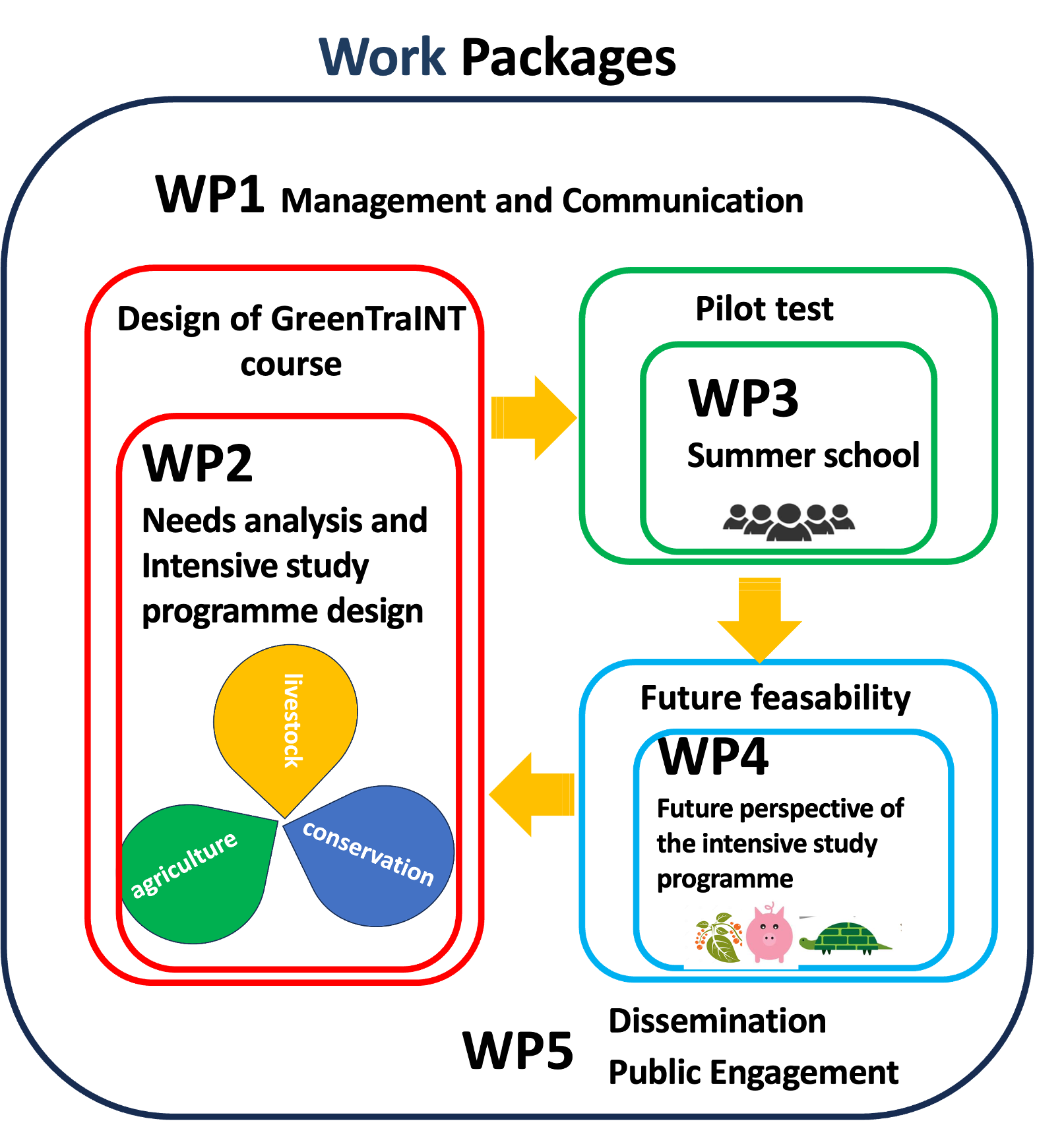
Project preparations, management, and communications (WP1) will be established to formulate and prepare detailed plans for implementation, quality control, activity coordination, management communication, administrative tasks, financial reporting, etc. Following a needs analysis, WP2 aims to design intensive programs with three specific paths in agriculture, livestock, and conservation. In WP3, a pilot summer school will be organized to test the content of the intensive program, and an evaluation survey by students and teachers will be conducted. Based on the evaluation results of the intensive programme content, WP4 will conduct a feasibility study to assess the program's viability and potential for extending the project's lifespan. WP5 will focus on developing the dissemination strategy and ensuring the fruition of project results with the active involvement of stakeholders.
STEERING COMMITTEE
Purpose
The Steering Committee's main role is to offer expert advice, guidance, and feedback throughout the project's duration and beyond its completion. This includes evaluating the project's resources, content, methodology, and outcomes. The committee will provide ad hoc input and participate in project activities as needed and appropriate. It will consist of external experts specializing in three key sectors: Agriculture, Animal Husbandry, and Biodiversity and Conservation.Terms of Reference
- Provide expert advice, guidance, and feedback throughout the project's duration and after its completion, ensuring consistent external input over its lifetime.
- Establish quality benchmarks by sharing personal and collective experiences.
- Analyze organizational, management, and partnership performance.
- Assess the quality of implemented activities and results, ensuring the final outcomes have a broader impact beyond immediate, anticipated benefits.
- Compare planned achievements with unforeseen results.
- Offer feedback on project outputs, exploitation plans, and intellectual property rights (IPR) protection.
- Disseminate project information and outcomes through their networks to maximize the project's impact post-completion.
- Expand the project's reach at local, regional, national, and international levels.
Frequency of Meetings
The Committee will provide individual feedback and communication as necessary through in-person or virtual meetings, emails, and phone calls. This will involve ad hoc participation in project activities when relevant. Virtual meetings will be held annually.
Minutes
Agendas will be distributed by the lead partner’s principal investigator one week before each Steering Committee meeting. Following each meeting, the lead partner’s project manager will prepare the minutes, which require approval from all Committee members. These minutes will serve as a key reference for project implementation.
Jurisdiction
The Steering Committee will oversee the resolution of conflicts, misunderstandings, and requests for clarification.